
CoachPinkston
February 9, 2026

If I had a dollar for every athlete who told me, “Coach, my head gets too busy in competition,” I’d retire early.
Overthinking is one of the most common—and costly—performance killers in sport. When the moment gets big, athletes often try to remember everything they’ve learned instead of trusting what matters most.
That’s why one of my go-to tools with athletes, coaches, and sport parents is something I call 3 Keys to Keeping It Simple.
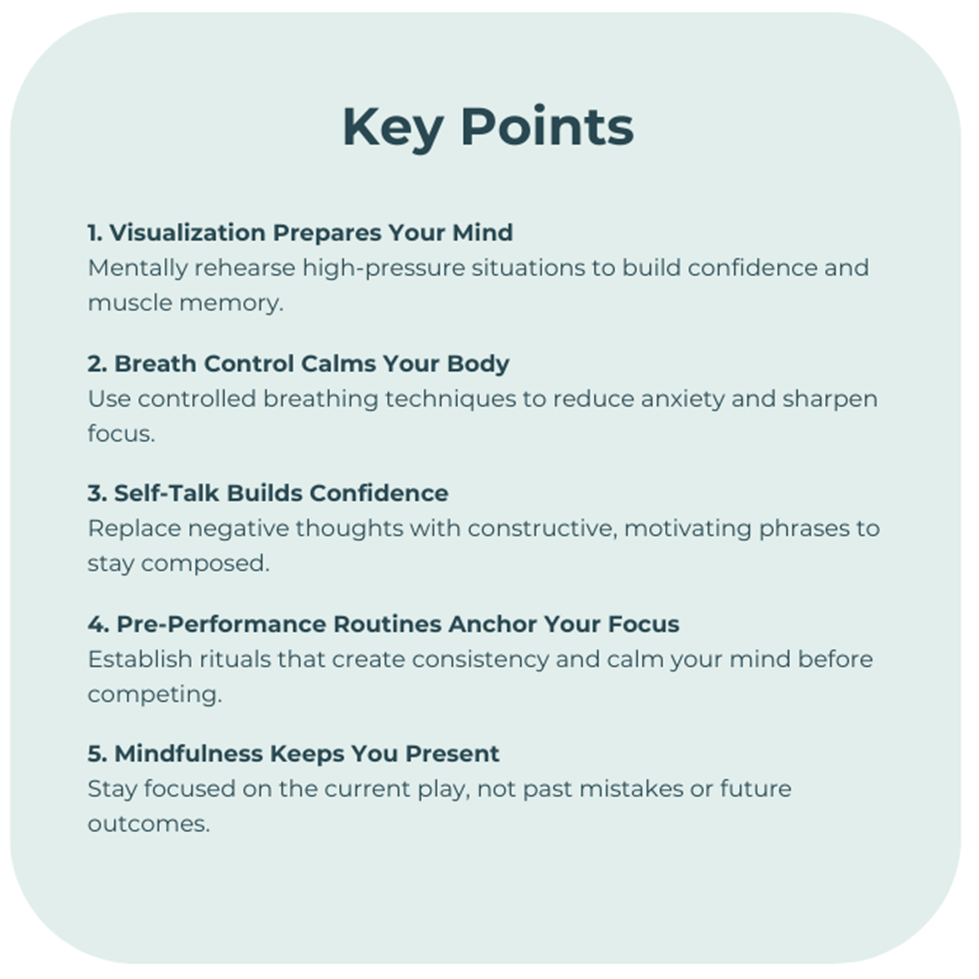
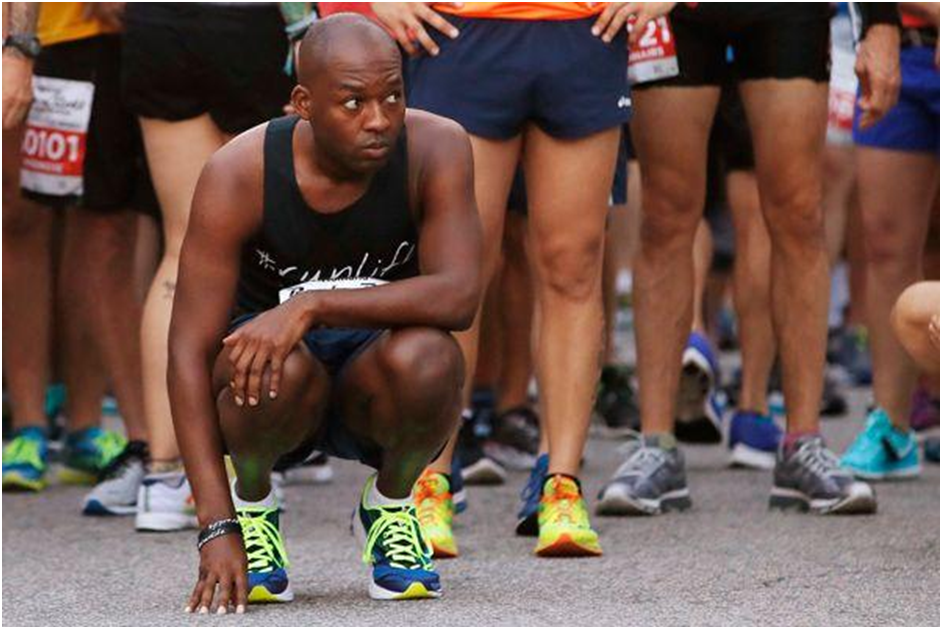
This strategy is simple by design—but don’t confuse simple with easy. When used correctly, it sharpens focus, reduces anxiety, and anchors athletes firmly in the present moment.
Let’s break it down
Under pressure, the brain does not perform better with more information—it performs worse.
Research in cognitive psychology consistently shows that working memory is limited, especially under stress. When anxiety rises, the brain’s capacity to process multiple thoughts shrinks. This is why athletes “blank out” or feel robotic when they try to control too many things at once.
As Nobel Prize–winning psychologist Daniel Kahneman explains in Thinking, Fast and Slow, stress pushes us away from deliberate, thoughtful processing and toward reactive thinking. In sport, that’s a dangerous place to live.
The solution isn’t more reminders.
The solution is clear priorities.
Here’s how I explain it to athletes in the locker room:
“Before competition, imagine you’re walking past a buffet that contains everything you’ve learned—technique cues, film notes, strength work, mindset strategies, feedback from coaches, advice from parents.
You can’t take it all with you. You’re only allowed three things on your plate.”
Those three things become your 3 Keys to Keeping It Simple.
Not ten.
Not seven.
Three.
Why three? Because it’s manageable, memorable, and actionable—especially when emotions run high.
3 Keys to Keeping It Simple are three primary focus points an athlete commits to during a workout, performance, or competition.
They can be:
The only rule:
They must be controllable and present-focused.
These keys act like anchors, pulling attention back to the present whenever the mind starts drifting to outcomes, mistakes, or expectations.
Studies in sports psychology show that simplifying cues improves execution under pressure. Research on attentional focus indicates that athletes perform better when attention is directed toward a small number of relevant cues rather than multiple internal corrections (Wulf & Lewthwaite, 2016).
Elite performance relies on well-learned skills running automatically. Overthinking disrupts this process—a phenomenon known as “paralysis by analysis.” Keeping just three keys protects automatic movement patterns.
Mindfulness-based approaches in sport emphasize attention to the now. The 3 Keys system functions as a practical, competition-ready version of mindfulness—without requiring athletes to sit cross-legged and meditate before kickoff.
Coaches, this is where you can make a massive impact.
Practices are where skills are learned. Competitions are where skills are trusted. Make that distinction clear.
Ask:
The same 3 Keys should show up:
Consistency builds confidence.
Athletes, here’s the truth:
Your 3 Keys are not motivational quotes. They are performance instructions.
When something goes wrong, don’t ask, “What did I mess up?”
Ask instead, “Which key do I go back to right now?”
That question alone can save a performance.
Parents, this tool isn’t just for athletes—it’s for your conversations, too.
Instead of postgame breakdowns filled with technical advice, try asking:
This reinforces process over outcome, which research shows is critical for long-term confidence and enjoyment in sport (Harwood et al., 2019).
Too many keys
If it doesn’t fit on one breath, it’s too much.
Outcome-based keys
“Win the race” is not a key. “Stick to my rhythm” is.
Changing keys mid-competition
Adjustments happen between performances—not in emotional moments.
I worked with a high school quarterback who struggled after interceptions. His mind raced, mechanics tightened, and confidence dipped.
We built his 3 Keys:
After mistakes, that was it. No film breakdowns. No lectures. Just keys.
Over the season, his composure improved dramatically—not because he learned more, but because he focused on less.
Keeping it simple is not something athletes naturally do—it’s something they’re trained to do.
3 Keys to Keeping It Simple:
And in high-pressure moments, present beats perfect every time.
Athletes: Before your next competition, write down your 3 Keys. Carry them with you. Commit to them.
Coaches: Build this into your pregame routine and halftime language.
Parents: Reinforce effort and focus—not stats and scores.
If you want help building individualized 3 Keys for your athletes or teams, that’s exactly what mental performance coaching is for.
Train your mind like you train your body—and keep it simple.